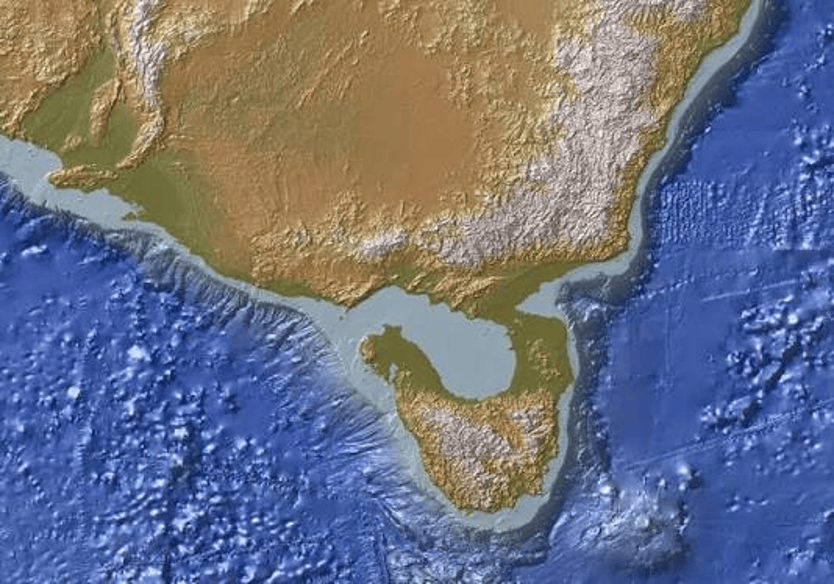
One of the best trips I took during my time in Australia was to the beautiful island of Tasmania. While reading about the island’s history, I came across a story that has stayed with me ever since. Around 10,000 years ago, rising sea levels cut the island off from mainland Australia, leaving its population of a few thousand people isolated. Over the following millennia, they appear to have gradually lost some of the skills they once had. Bone tools, probably used for making warm clothing and spearing fish, stop appearing in the archaeological record around 3,500 years ago. By the time Europeans arrived, the Tasmanian toolkit consisted of around two dozen items, compared with hundreds on the mainland.
I don’t think Tasmanians became less intelligent. There simply weren’t enough people, and enough connections between them, to keep that toolmaking knowledge alive. If a skill lives in the heads of two people in a small group, one bad winter is enough to wipe it out. I feel this small story says something big about human progress and, perhaps surprisingly, about my own field.
Progress is less about inventing and more about keeping
Tasmania is an extreme case, but not an isolated one. For most of the roughly 300,000 years our species has been around, humans were perfectly capable of inventing things. They just struggled to hold on to them. Inventions appear in the archaeological record, disappear for thousands of years, and then get reinvented somewhere else by people who had no idea they had already existed.
Things only changed once people settled around agriculture and livestock, populations grew, cities were born and skills were held by many people rather than a few. Trade then allowed ideas to travel across large areas, so an invention only had to happen once, and writing allowed knowledge to outlive the people who produced it.
This shift – from knowledge tied to individual survival to knowledge stored collectively – is what really kicked off the exponential curve of human progress. Each generation no longer had to reinvent the wheel: it could start from where the previous one left off and add something on top. Once we started passing down complex ideas reliably, there was no turning back.
Even then, progress stayed slow while written knowledge lived in a handful of hand-copied manuscripts that hardly anyone could check. Gutenberg’s printing press in the 15th century changed that. Thousands of identical copies meant that people in different places could read, test and challenge the same ideas, making knowledge not just durable but comparable and correctable. Later on, things accelerated further as we built tools that worked on knowledge itself: scientific journals, research labs, computers and now AI.
The common thread is that the bottleneck to progress was never brains. It was how well knowledge could be kept, connected and built upon.
Our most precious asset
Looking at history this way, I’d argue that accumulated knowledge is the most precious thing humankind has ever produced. Not any single invention, but the whole pile of it – built up over countless generations by people who never met, each adding a little to what they inherited. Practically everything we take for granted today, from vaccines to the phone in your pocket, rests on it.
Tasmania is a reminder that this asset doesn’t look after itself. Knowledge only accumulates when there are good enough tools to store it, check it and pass it on. Take those away and it can quietly erode.
Is behavioural science still copying manuscripts by hand?
I am not suggesting behavioural scientists are working by candlelight, but I do think some of these parallels are uncomfortably close. Our problem is not a lack of ideas or studies – every year we develop and evaluate a large number of behaviour change interventions. The problem is how well the knowledge they produce is kept, communicated and built upon. Much of what we learn from these studies stays locked in the text of individual papers, for two main reasons:
• Most interventions are only partially described, without a full account of what really happened as part of the intervention and its evaluation, and they are often reported inconsistently (the same ideas travel under different names and different ideas under the same name).
• Bringing studies together still relies largely on systematic reviews done by hand, which can take years to complete and often develop their own bespoke coding schemes that are rarely reused.
None of this means knowledge is being lost the way it was in Tasmania, but it does mean it accumulates far less efficiently than it could. The consequence is that each new intervention team risks reinventing the wheel to some extent – not starting from scratch, but starting much further back than they should, given everything that has already been tried and tested.
Ontologies: infrastructure for accumulating knowledge
If accumulated knowledge really is our most precious asset, then how we store it matters. This is why I have become interested in ontologies over the past few years. In computer and information science an ontology is a formal, standardised representation of a domain: a set of agreed classes (each with a definition and a unique ID) and the relationships between them, written so that both humans and machines can read them.
In behavioural science, the most developed example is the Behaviour Change Intervention Ontology (BCIO), which offers a shared vocabulary for describing – or “tagging” – interventions and their evaluations. As a simplified example, a school-based intervention to increase physical activity among teenagers could be coded with the following BCIO classes, with the relevant subontology in brackets: ‘secondary school’ (setting), ‘teenagers’ (population), ‘face-to-face’ (intervention mode of delivery), ‘physical activity’ (behaviour), and ‘social support’ and ‘set behaviour goal’ (behaviour change techniques).
Thinking back to the printing press, I see ontologies doing two similar things for behavioural science. They make knowledge comparable, because studies described with the same standardised terms can be checked against each other and combined with more confidence. And they make knowledge machine-readable, which means computers and AI can help us store, connect and build on the evidence at a scale and speed no team of reviewers could manage.
Wouldn’t it be amazing if all behaviour change interventions were consistently added to a common database under the same (machine-friendly) coding scheme? This could then be used for multiple purposes, from rapidly scoping the literature to identify gaps, to developing algorithms that draw on existing studies to predict the likely outcomes of new interventions.
Unfortunately, we are not there yet. Representing the existing evidence base with ontology classes is a big task, and not one any single team can tackle alone. It will take a coordinated effort across the field: agreeing on a shared, consensus-based coding scheme, and then making sure it is actually used widely. The good news is that momentum is building: a 2022 report from the US National Academies of Sciences, Engineering, and Medicine highlighted the potential of ontologies to make behavioural science evidence “searchable and more easily integrated”, and the US National Institutes of Health has since launched an initiative to support ontology development in the behavioural and social sciences.
What will we hand over?
A NASA engineer designing satellites today has the same brain as someone carving patterns into a piece of ochre tens of thousands of years ago. What separates them is not intelligence but what each of them inherited: a few things learned from the people around them in one case, and thousands of years of recorded and tested knowledge in the other.
I think the same applies to our field. The next generation of behavioural scientists will not be smarter than us – but they could inherit a much richer and more usable body of evidence, if we make the effort to structure it properly now. I’m hopeful that ontologies will be a big part of that, and I am looking forward to seeing (and hopefully contributing to) how this area develops over the coming years!
References
• Castro, O., Mair, J. L., von Wangenheim, F., & Kowatsch, T. (2024). Taking behavioral science to the next level: Opportunities for the use of ontologies to enable artificial intelligence-driven evidence synthesis and prediction. In Proceedings of the 17th International Joint Conference on Biomedical Engineering Systems and Technologies (BIOSTEC 2024), 2, 671–678. https://doi.org/10.5220/0012437300003657
• Henrich, J. (2016). The secret of our success: How culture is driving human evolution, domesticating our species, and making us smarter. Princeton University Press.
• National Academies of Sciences, Engineering, and Medicine. (2022). Ontologies in the behavioral sciences: Accelerating research and the spread of knowledge. The National Academies Press. https://doi.org/10.17226/26464


Leave a Reply