I have been featured in the International Society for Physical Activity and Health (ISPAH) Early Career Network. This involved answering questions about my current position and the key lessons learned throughout my career (the full interview is available below and will soon be available on ISPAH’s website and social media channels). Some questions were challenging but it was definitely a fantastic opportunity for self-reflection! 🙂
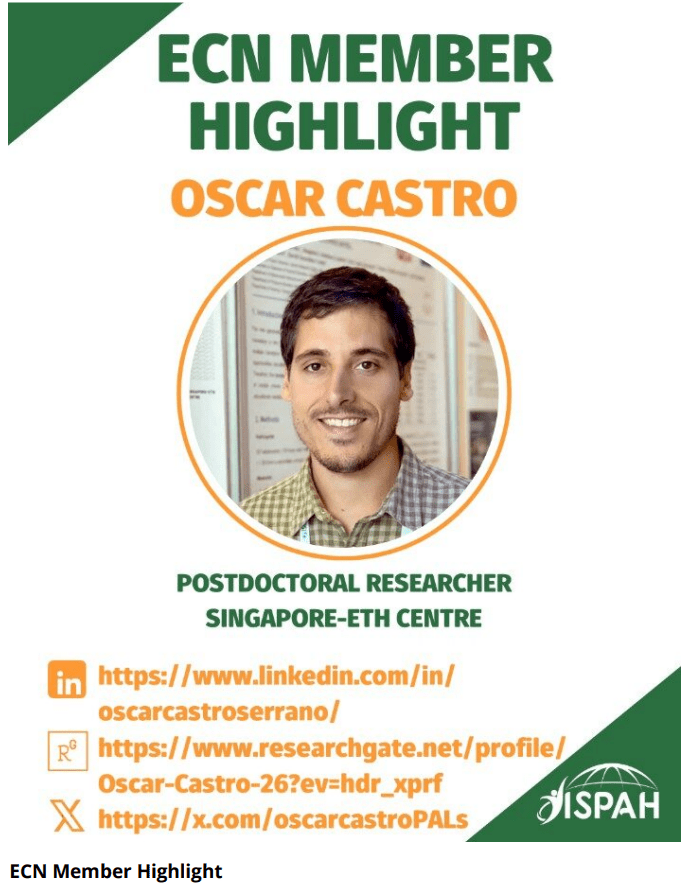
Please tell us about your current work (e.g. PhD work, Post-doc work, research, teaching)
I am a postdoctoral researcher with the Future Health Technologies programme (Singapore-ETH Centre). As part of my role, I have contributed to the development of “LvL UP”, a mobile health lifestyle intervention aimed at helping adults prevent non-communicable diseases and common mental disorders. Currently, I am focused on optimising and evaluating the intervention through a sequential, multiple-assignment randomised controlled trial (SMART).
What are your main research interests?
I am interested in the development, evaluation and synthesis of behaviour change interventions, with a focus on physical activity and sedentary behaviour. In recent years, I have become particularly interested in evidence synthesis and the use of scientific ontologies to support efficient knowledge organisation, integration and analysis. Ontologies are formal structures that specify concepts within a given domain via standardised and computer-readable labels.
What do you enjoy most about your work?
The opportunity it has given me to live and work in diverse settings, including five countries across Europe and Asia-Pacific. I enjoy working with people from different cultural backgrounds and I think this has greatly contributed to both my scientific career and personal growth.
What is a key challenge you have overcome with your work?
While I have always felt at ease with writing and processing things slowly in the solitude of my room, research also demands strong oral communication and interpersonal skills such as presenting findings, discussing ideas, or persuading others of their value. Developing such skills has been challenging, particularly as a non-native English speaker, but I am now more confident in navigating these aspects of academic life.
What piece of advice would you give to other members of ISPAH ECN?
Here are three (rather eclectic) pieces of advice based on my experience:
– Embrace interdisciplinary collaboration. Don’t shy away from working with researchers and practitioners from other fields. I firmly believe science thrives on interdisciplinary collaborations and physical activity research is no exception. Wearables, artificial intelligence, advanced data analysis techniques… the field is becoming more technical!
– Develop a ‘get-things-done’ mindset. I have struggled with this myself, but I would advise to try and learn how to manage perfectionism, procrastination, distractions from flashy new ideas or whatever prevents you from getting things to the finish line. There are great strategies out there – for example, the Pomodoro technique has been a lifesaver for me.
– Be strategic about your career choices and seek guidance. Take time to reflect on your goals and make it a habit to discuss them regularly with your supervisor or mentor. Good mentors can be hard to come by, so don’t hesitate to look beyond your immediate team for support and advice.
What could help you as a student/ECR to further develop/grow in your current position?
If I had to choose just one thing, it would be more dedicated funding schemes that allow ECRs to lead independent projects. It is hard to break the postdoc cycle and start building your scientific independence – further opportunities in this regard would make a meaningful difference.
Tell us about one other hobby you have outside of your work?
One of my main hobbies is tennis – whether it is playing, coaching, or following the professional tour. I actually started my career in the area of sport psychology, as a way to combine my academic background in psychology with my passion for the sport. Beyond tennis – and probably influenced by having always lived near the sea – I have a strong appreciation for mountains and enjoy hiking whenever I get the chance.
 Oscar Castro
Leave a comment