The Behaviour Change Wheel (BCW) is an intervention development framework that provides a comprehensive guide for understanding and changing behaviour. Aiming to synthesise existing frameworks of behaviour change into a single, coherent approach, it consists of different ‘layers’ which are meant to guide intervention developers through a systematic set of steps: Capability, Opportunity, Motivation-Behaviour (COM-B) model, intervention functions (e.g., education, environmental restructuring) and policy categories (e.g., legislation, fiscal measures).
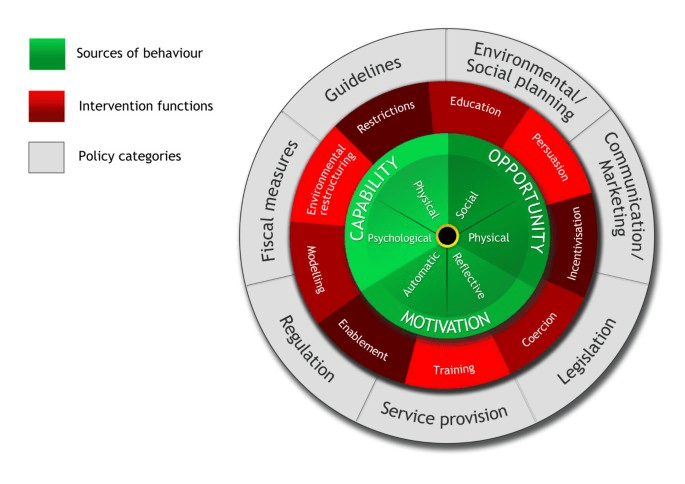
I suspect I am not alone in saying that the BCW and associated suit of tools have been highly influential throughout my career in behavioural science. The BCW (including the COM-B and Theoretical Domain Framework components) is considered by many the gold standard of behaviour change intervention design as it provides a systematic, comprehensive and theory-informed approach to identify determinants of behaviour and a clear rationale for the specific content of the intervention. The BCW has underpinned the development of hundreds of behaviour change interventions worldwide and can also complement and be well-integrated within broader research frameworks (e.g., preparation phase in the Multiphase Optimization Strategy (MOST) framework or development phase in the UK’s Medical Research Council guidelines for developing and evaluating complex interventions).
However, this blog post is not aimed at providing a detailed overview of the BCW nor highlight its (many) benefits. For that you can see this great blog post or go to the source materials. I would like instead to reflect on a couple of caveats around the BCW eco-system, drawing from my experience designing behaviour change interventions using primarily the BCW approach. This is certainly not a critique but rather a series of suggestions for intervention developers to complement and expand their BCW horizons.
Interventions are (much) more than intervention content
It is important to understand that the BCW is primarily focused on developing intervention content and, while this is essential for any behaviour change intervention, it is not the only element for consideration. Other key design aspects such as how these intervention techniques are going to be delivered (i.e., mode of delivery), over what period (i.e., schedule), or by whom (i.e., source) are not directly addressed by the BCW.
For example, a rich literature exists on person-centred, counselling approaches that have been shown to be effective in helping people change health-related behaviours such as motivational interviewing. Motivational interviewing places special emphasis on the vocabulary for change and type of communication used during the delivery of the intervention (i.e., the style of delivery), something that is not appropriately covered within the BCW (focused on identifying behaviour change techniques).
Integrating both approaches might help intervention developers to incorporate the added benefits of using the BCW (e.g., comprehensive model of behaviour, clear and systematic path to developing intervention content), while also taking into account a range of elements that have been proved to be relevant when helping people to change such as motivational interviewing type of communication, support of basic psychological needs (i.e., self-determination theory), or tailoring of BCTs depending on the participant’s stage of change (i.e., transtheoretical model).
The BCW authors recognise the important role of other intervention elements aside from content (behaviour change techniques) and this is behind the development of a wider framework to capture all relevant aspects of behaviour change interventions: The Behaviour Change Intervention Ontology (BCIO). The BCIO offers a set of pre-defined set of ‘classes’ (each with unique IDs) for describing behavioural interventions in detail, covering intervention content, engagement, population, setting, target behaviour, mechanisms of action, and delivery (including mode, source, style and schedule). While not having any theoretical basis, the BCIO might help intervention designers to be more systematic and comprehensive when thinking of interventions and go beyond behaviour change techniques.
The important role of time in behaviour change
A key aspect of the BCW consists of using the COM-B model to draw a behavioural diagnosis (i.e., what needs to be changed to bring about behaviour change?). While I do not think this is explicitly prescribed by the BCW, the way in which the framework is often implemented involves conceptualising this behavioural diagnosis as a fixed picture. The factors that influence behaviour, however, are highly dynamic and depend on both time and contextual factors. We could talk in fact of multiple behaviour diagnoses, which are equally valid for the same behaviour but would apply to different contexts or periods throughout the day. The BCW addresses this issue by prompting intervention developers to define and focus on a rather narrow target behaviour. However, this might not be possible for all use cases and does not capitalise on Just-in-Time Adaptive Interventions (JITAIs) or other personalised approaches to delivering interventions that adjust based on people’s real-time needs.
Conclusions
The BCW provides practitioners and researchers with a common language and a how-to framework for applying behavioural science to various domains. I am not aware of any equivalent in the behavioural science literature that is as comprehensive and extensively used as the Behaviour Change Wheel. I think, however, that the way in which the BCW is often applied neglects other relevant considerations for behaviour change and through this post I wanted to make two of them more apparent to hopefully make your BCW approach even better. The BCW was never conceptualised as a rigid or limited model but rather as a flexible starting point for understanding and changing behaviour, and so we can expect new developments to be introduced over time as behavioural science progresses and reaches new heights.
 Oscar Castro
Leave a comment